In today’s fast-moving Indian market, logistics is no longer just about transporting goods from point A to point B. It plays a strategic role in:
-
Cost optimization
-
Customer satisfaction
-
Business scalability
-
Long-term growth
To choose the right logistics approach, businesses must understand the 1PL to 5PL logistics models and how each fits specific operational needs.
This guide explains:
-
What 1PL, 2PL, 3PL, 4PL, and 5PL mean
-
Their differences
-
Advantages and challenges
-
How Indian businesses can select the right model
What Is a Logistics Model?
A logistics model defines how supply chain activities are managed, including:
-
Transportation
-
Warehousing
-
Inventory management
-
Technology integration
-
Vendor coordination

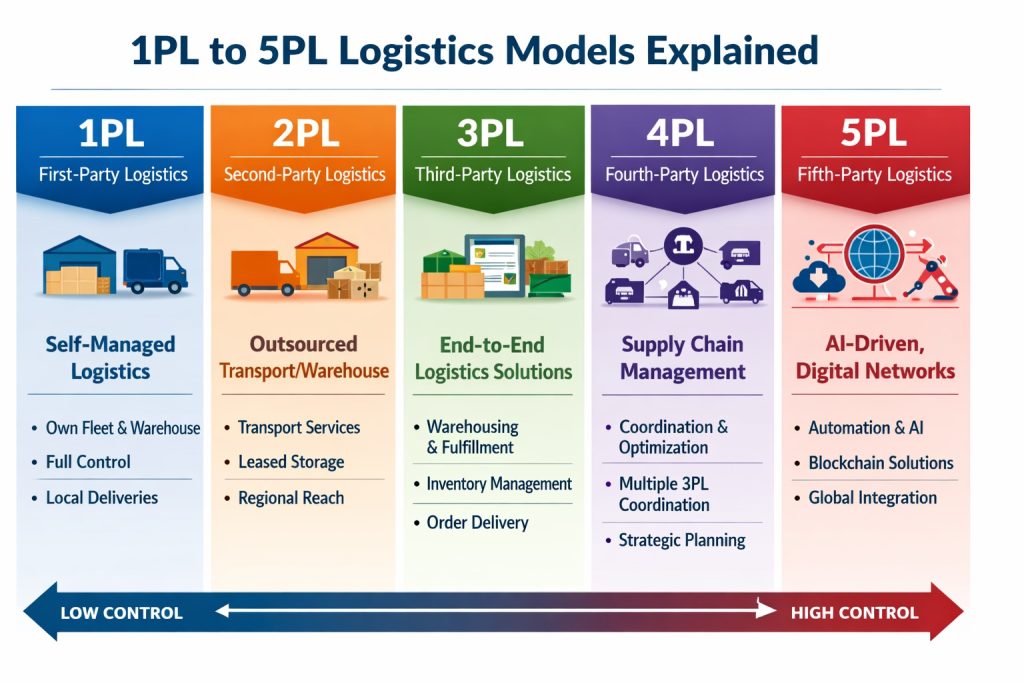
Logistics models range from self-managed systems (1PL) to fully digital, AI-powered supply chains (5PL).
1PL (First-Party Logistics)
What is 1PL?
1PL refers to self-managed logistics, where a company handles all operations internally without outsourcing.
Example
-
A manufacturer using its own trucks and warehouses
-
Local traders delivering goods directly to customers
Key Features
-
Full ownership of logistics assets
-
Complete operational control
-
No external service providers
Advantages
-
High operational control
-
Customization flexibility
-
No third-party dependency
Limitations
-
High capital investment
-
Difficult to scale
-
Limited geographic reach
Best For
-
Small businesses
-
Local manufacturers
-
Businesses with limited delivery areas
2PL (Second-Party Logistics)
What is 2PL?
2PL involves outsourcing specific logistics functions such as transportation or warehousing while retaining overall control.
Example
-
Hiring a transport company for interstate shipments
-
Leasing third-party warehouses
Key Features
-
Asset-based providers
-
Transaction-focused services
-
Limited service scope
Advantages
-
Reduced capital expenditure
-
Access to professional transport networks
-
Improved efficiency
Limitations
-
No end-to-end management
-
Limited technology integration
-
Requires internal coordination
Best For
-
SMEs expanding regionally
-
Businesses with predictable shipping volumes
3PL (Third-Party Logistics)
What is 3PL?
3PL providers manage end-to-end logistics operations, including:
-
Transportation
-
Warehousing
-
Inventory management
-
Order fulfillment
Example
-
E-commerce fulfillment partners
-
Warehousing + last-mile delivery providers
Key Features
-
Integrated logistics services
-
WMS, TMS & tracking tools
-
Contract-based partnerships
Advantages
-
Cost optimization
-
Faster order fulfillment
-
Focus on core business growth
Limitations
-
Reduced direct control
-
Provider dependency
-
Customization limitations
Best For
-
E-commerce businesses
-
Retail chains
-
Growing D2C brands in India
4PL (Fourth-Party Logistics
What is 4PL?
4PL acts as a single supply chain integrator that manages and optimizes multiple 3PL providers.
Example
-
A logistics integrator coordinating transporters, warehouses, and tech platforms
Key Features
-
Strategic supply chain management
-
Vendor orchestration
-
Data-driven optimization
Advantages
-
End-to-end visibility
-
Optimized logistics cost
-
Improved risk management
Limitations
-
Higher cost than 3PL
-
Dependence on one integrator
-
Complex implementation
Best For
-
Large enterprises
-
Pan-India operations
-
Manufacturing & FMCG companies
5PL (Fifth-Party Logistics)
What is 5PL?
5PL focuses on digitally driven, AI-powered logistics ecosystems, managing multiple supply chains simultaneously.
Example
-
E-commerce aggregators using AI, blockchain & automation
-
Cloud-based logistics ecosystems
Key Features
-
Advanced analytics & automation
-
Digital end-to-end integration
-
Demand forecasting & optimization
Advantages
-
Maximum scalability
-
Lower long-term logistics costs
-
Ideal for high-volume businesses
Limitations
-
High technology dependency
-
Limited availability in India
-
Complex onboarding
Best For
-
Large e-commerce platforms
-
Global supply chains
-
Tech-driven enterprises
Comparison: 1PL to 5PL at a Glance
| Model | Control Level | Technology | Cost | Scalability |
|---|---|---|---|---|
| 1PL | Very High | Low | High | Low |
| 2PL | High | Low–Medium | Medium | Medium |
| 3PL | Medium | Medium–High | Optimized | High |
| 4PL | Low–Medium | High | Higher | Very High |
| 5PL | Low | Very High | Optimized (Long Term) | Maximum |
How Indian Businesses Should Choose the Right Logistics Model
Ask these key questions:
-
What is your business size & order volume?
-
Are operations local or Pan-India?
-
Do you need automation & technology integration?
-
What is your budget vs scalability goal?
-
What are your customer delivery expectations?
Quick Recommendation
-
Startups & SMEs → 1PL / 2PL
-
E-commerce & D2C brands → 3PL
-
Large enterprises → 4PL
-
Tech-driven high-volume businesses → 5PL
Future of Logistics Models in India
With the rise of:
-
E-commerce expansion
-
ONDC ecosystem
-
AI, IoT & blockchain adoption
-
Same-day & hyperlocal deliveries
Indian businesses are rapidly shifting toward 3PL+, 4PL, and 5PL logistics models, creating smarter, faster, and more secure supply chains.
Conclusion
Understanding the 1PL to 5PL logistics models is essential for Indian businesses aiming to remain competitive in today’s dynamic market.
The right logistics model helps you:
-
Reduce operational costs
-
Improve efficiency
-
Enhance customer experience
-
Enable sustainable growth
Choosing the right logistics strategy today ensures long-term business success.
Explore Professional Logistics Solutions
Visit: https://safeandsecure.in/
FAQs
What is the difference between 1PL and 5PL logistics?
1PL is fully self-managed logistics, while 5PL uses AI, automation, and advanced digital systems to manage multiple supply chains.
Which logistics model is best for Indian SMEs?
2PL or 3PL logistics models are ideal for SMEs due to lower cost, scalability, and professional support.
Is 3PL suitable for e-commerce businesses in India?
Yes, 3PL is widely used for warehousing, order fulfillment, and last-mile delivery in Indian e-commerce.
What industries use 4PL logistics in India?
Manufacturing, FMCG, pharmaceuticals, and large retail enterprises commonly use 4PL logistics.
Is 5PL logistics available in India?
5PL is emerging in India and is mainly used by large e-commerce platforms and tech-driven enterprises.